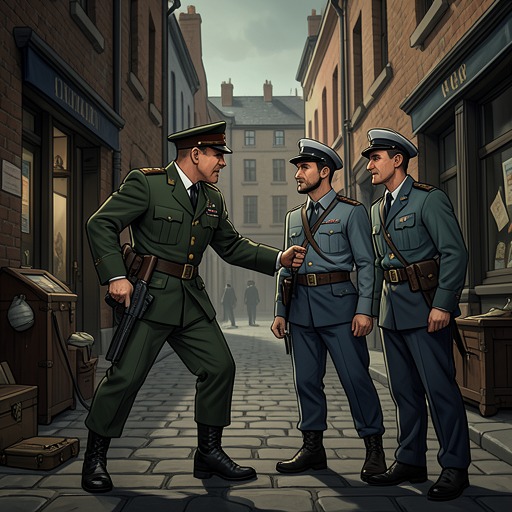
Cantwell's fight with two sailors
Across the River and into the TreesRichard Cantwell’s confrontation with two sailors begins with a deliberate warning and ends with him walking away beside Renata. Recalled later while he searches his memories for the source of a personal change he cannot explain, the encounter turns on a choice: he first treats the sailors’ whistles as harmless, then recognizes that their conduct requires a response. His handling of the moment is at once protective and controlled, but its conclusion remains modest and uncertain; he can leave the scene, not settle what it means for his career or for the larger mystery he is considering.
Cause and Recognition
Cantwell remembers the incident as one possible moment that helped bring about what he calls a miracle, though he does not claim to know whether this particular day caused it. His recollection begins with an admission against his later action: when the two sailors first whistle at Renata as they walk at night, he thinks the gesture harmless and that he ought to have ignored it. Something nevertheless seems wrong to him before he can identify why. The gap between that first judgment and his growing certainty supplies the scene’s central turn.
He stops beneath a light so the sailors can see the small silver-thread eagles embroidered on each shoulder of his coat. The insignia is neither conspicuous nor new, but it is visible. In stopping there, Cantwell makes his rank legible and gives the men an opportunity to recognize who is asking them to keep their distance. They whistle again. The sign does not end the encounter, and their persistence confirms his earlier unease. The scene thus moves from an ambiguous public slight to a direct challenge without suggesting that the first whistle alone had already made his decision inevitable.
Confrontation
Before approaching the sailors, Cantwell tells Renata that she may wait against a wall or look away. She answers that the men are young and large; he assures her they will not be so for long. His words prepare her for a confrontation, while his instruction gives her a choice about whether to watch. She remains present. The exchange establishes that Cantwell is not acting in isolation: he acknowledges Renata’s position and lets her decide how closely to witness what follows.
Cantwell crosses to the sailors and asks where their shore patrol is. The largest replies that he does not know and makes clear that he wants to look at Renata. The other sailor then insults Cantwell rather than answer him. In his thoughts, Cantwell identifies the man as an old army boy and a sea lawyer, someone familiar with his rights. That recognition connects the street encounter to military life: Cantwell understands the man’s defiance not simply as youthful insolence but as a practiced confidence about what can be challenged.
The exchange gives way to a brief physical fight. Cantwell strikes the second sailor as the man begins to move, then turns to face the first, who closes on him quickly despite having been drinking. Cantwell uses his elbow and fists against the attackers, checks the man who was hit first, and sees that he is peacefully asleep. He then turns away from the other sailor rather than remain to hear him fall. The encounter ends not with a prolonged pursuit or a further exchange, but with Cantwell checking the immediate result and choosing to leave.
Departure and Immediate Consequences
Returning to Renata, Cantwell makes a dry remark about the possible damage to his career and about the sailors’ clothes. The joke does not erase the risk he has just taken; it gives him a way to speak of it without turning the aftermath into triumph. Renata asks how he is and confirms that she watched. Cantwell says that his hands may be in poor condition the next morning, then suggests they walk away slowly. When she asks him to do so, he clarifies that he means they should not hurry their departure. His attention shifts from the confrontation to getting the two of them calmly away from it.
The scene leaves the consequences limited but clear. Cantwell expects some cost to his career, although the narrative does not confirm that a formal consequence follows. He anticipates discomfort in his hands but does not describe it in detail. The men’s behavior has been stopped for the moment, and Cantwell and Renata leave together. His final emphasis on walking slowly makes composure, rather than victory, the last practical decision of the encounter.
Recollection and Significance
The later recollection places the fight within Cantwell’s effort to understand what produced a change he calls a miracle. He cannot tell whether it was this day or another, and he admits that he neither consciously brought the change about nor opposed it. The uncertainty matters: the memory offers an instance of decisive action, not an explanation that closes his search. The scene is presented as one candidate among experiences whose effects he cannot fully account for.
The episode also complicates any simple distinction between Cantwell’s restraint and his capacity for violence. He initially considers overlooking the whistles; once he judges that something is wrong, he makes his rank visible, gives Renata room to choose whether to watch, asks after official authority, and then intervenes when the sailors persist. His action is forceful, but the sequence is shaped by warning, recognition, and departure as well as by the fight itself. In this recollection, protection is not presented as a speech or a declaration: it is a series of choices whose immediate outcome is that Cantwell and Renata can walk away together.